Samantha Heath
There is no such thing as a ‘blank space.’ Spaces, whether physical, virtual or a hybrid, are living and breathing. When we enter a space, our bodies join it and start to become a part of its history. We can manipulate space and change it as we play within it. The concept of ‘space’ is extremely large so there will be some things within this post that are missing. For the purposes of defining space in relation to digital performance, I will be looking at ways we think about virtual and hybrid spaces.
Virtual Space
Virtual spaces have the potential to take us out of our physical environment and into another world. With the expansion of virtual reality (VR) technologies, there is potential for more theatre productions to take place in virtual spaces. An example of a new VR production is Hamlet VR Experience, a project led by University of Guelph professor Peter Kuling. In this experience, participants put on a virtual reality headset to become the guard Bernardo in the opening scene of Hamlet, moving through a 3D world, with Elsinore castle next to them. In this virtual space, Hamlet’s father’s ghost floats in the air and lurks in the castle gardens, moments that would be technically challenging in a physical theatre space. The audience member interacts with the space using VR controllers, which leads to a disconnect between what they should be feeling (such as a lantern they can pick up) and what they are actually touching (smooth VR controllers). While this sense of touch may be removed, the audience member is visually immersed and can move around, following the other characters in the scene.
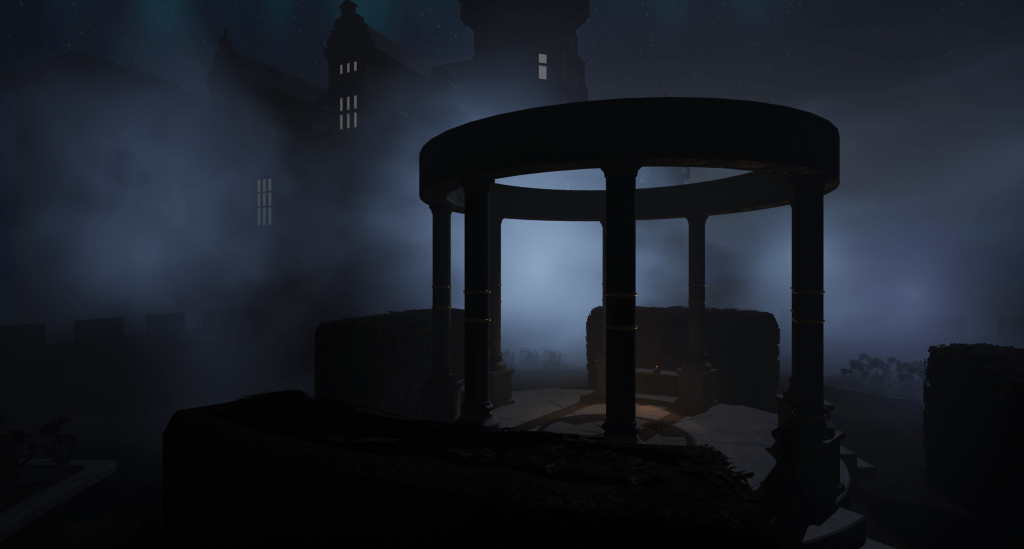
Screenshot from Hamlet VR Experience (2022) dir. Peter Kuling
In a physical space the body is usually extremely present, in a virtual space the body—or our sense of body—becomes, to use Sita Popat’s phrase, “missing in action” (361). The act of placing the glasses onto the body rather than spending the time traveling to a space can influence the spectators’ experience. Instantaneously, the spectator is brought into the world and just as fast they are brought out of it. This sensation can be jarring, leading to vertigo and confusion as the participant exits an experience.
Virtual spaces are rapidly developing, making experiences feel more real as digital rendering evolves. It is interesting to look into performance pieces like Kuling’s and ask where else can this go? How far can an audience member be fully brought into a brand new space? Is it possible to adapt it to feel as natural to us as a physical space?


Hybrid Space
Oliver Grau refers to a hybrid space as “a combination of projection screen and viewing room, which does not alienate the observers from their own physical perception” (qtd. in Benford and Giannachi 5). A hybrid space takes on the identities of both a physical space and virtual space to make something that blends the two. Creators might use digital projection or sound to augment or transform a physical space, allowing for new connections to be made. Kaha:wi Dance Theatre does this beautifully with their performance Continuance: Yonkwa’nikonhrakontáhkwen – Our Consciousness Continues Unchanged, which was part of the National Arts Centre’s Grand Acts of Theatre series in 2020 (https://nac-cna.ca/en/video/gat-continuance-Kahawi). The series consisted of outdoor performance that responded to the current moment in time. Each performance was recorded and made available on the NAC website. In Continuance, Haudenosaunee dancers performed on the grounds of Mohawk Institute Residential School. Behind the dancers, on the school building, 3D projection mappings altered the façade, morphing it through images that highlighted “cultural strength, beauty and iconic Haudenosaunee imagery” (“Grand”). This example highlights how digital layers can transform a physical space, in this case in order to manifest Indigenous resilience and resistance.
Works Cited
Benford, S., & Giannachi, G. (2011). Performing mixed reality. MIT Press.
“Grand Acts of Theatre: Continuance: Yonkwa’nikonhrakontáhkwen – Our Consciousness Continues Unchanged.” National Arts Centre. https://nac-cna.ca/en/video/gat-continuance-Kahawi. Accessed 5 June 2023.
Popat, Sita. “Missing in Action: Embodied Experience and Virtual Reality.” Theatre Journal, vol. 68, no. 3, 2016, pp. 357–78.
 Digital performance repository